library(tidyverse)
library(readxl)

path = "Excel/642 List Alphabets and Numbers.xlsx"
input = read_excel(path, range = "A2:A22")
test  = read_excel(path, range = "B2:C8")

result = input %>%
  mutate(group = consecutive_id(str_detect(Data, "^[a-z]"))) %>%
  summarise(Data = paste(Data, collapse = ", "), .by = group) %>%
  mutate(type = ifelse(group %% 2 == 0, "Number", "Alphabet"),
         group2 = ceiling(group / 2)) %>%
  select(-group) %>%
  pivot_wider(names_from = type, values_from = Data) %>%
  select(-group2)

all.equal(result, test)
#> [1] TRUEExcel BI - Excel Challenge 642
excel-challenges
excel-formulas
🔰 List all consecutive alphabets in Data column separated by comma.
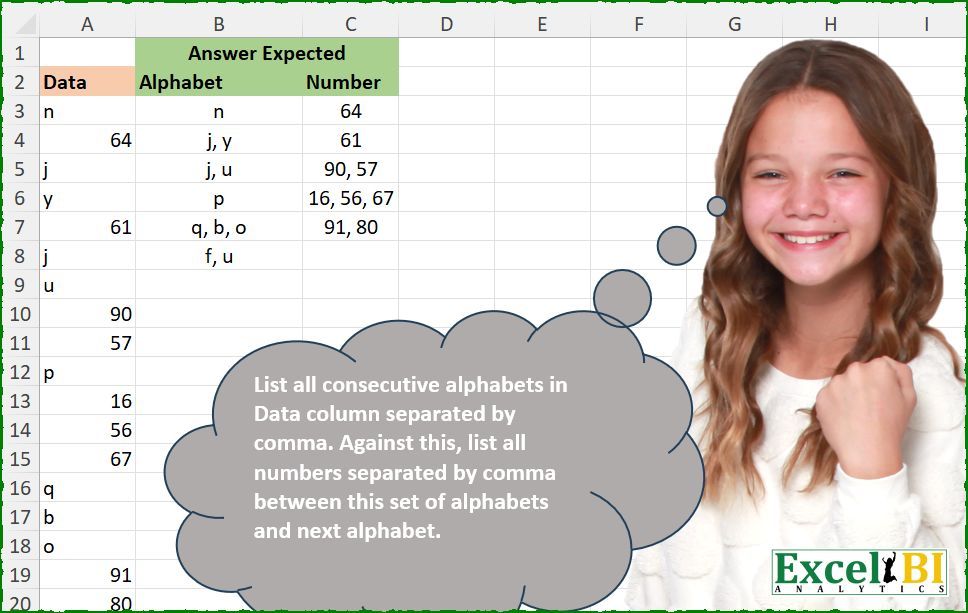
Challenge Description
🔰 List all consecutive alphabets in Data column separated by comma. Against this, list all numbers separated by comma between this set of alphabets and next alphabet.
Solutions
- Logic: Read the workbook ranges needed for the challenge; Derive the required intermediate columns; Aggregate or rank the data at the required grouping level; Reshape the result into the workbook output format.
- Strengths: The reshaping step mirrors the workbook output closely instead of forcing extra post-processing.
- Areas for Improvement: The solution assumes the workbook layout and selected ranges remain stable, so any structural change in the sheet would require small adjustments.
- Gem: The last reshape turns a raw transformation into something that already looks like a report.
import pandas as pd
import re

path = "642 List Alphabets and Numbers.xlsx"
input = pd.read_excel(path, usecols="A", skiprows=1, nrows=21)
test = pd.read_excel(path, usecols="B:C", skiprows=1, nrows=6).fillna("").astype(str)

input['type'] = input.iloc[:, 0].apply(lambda x: 'Alphabet' if re.match(r'[A-Za-z]', str(x)) else 'Number')
input['consecutive_id'] = (input['type'] != input['type'].shift()).cumsum()
input['Data'] = input['Data'].astype(str)

result = input.groupby('consecutive_id').agg({'Data': ', '.join, 'type': 'first'}).reset_index(drop=True)
result['group'] = result.index // 2

pivot_result = result.pivot(index='group', columns='type', values='Data').reset_index(drop=True).fillna("")
pivot_result.columns.name = None

print(pivot_result.equals(test)) # True
The Python version follows the same grouped logic and keeps the transformation explicit in a dataframe pipeline.
Difficulty Level
Medium
The individual steps are manageable, but the correct transformation pattern is not obvious from the raw data.